


Federation of Creative Industries’ Community Meeting Explores AI and the Future of the Creative Economy Through 2030
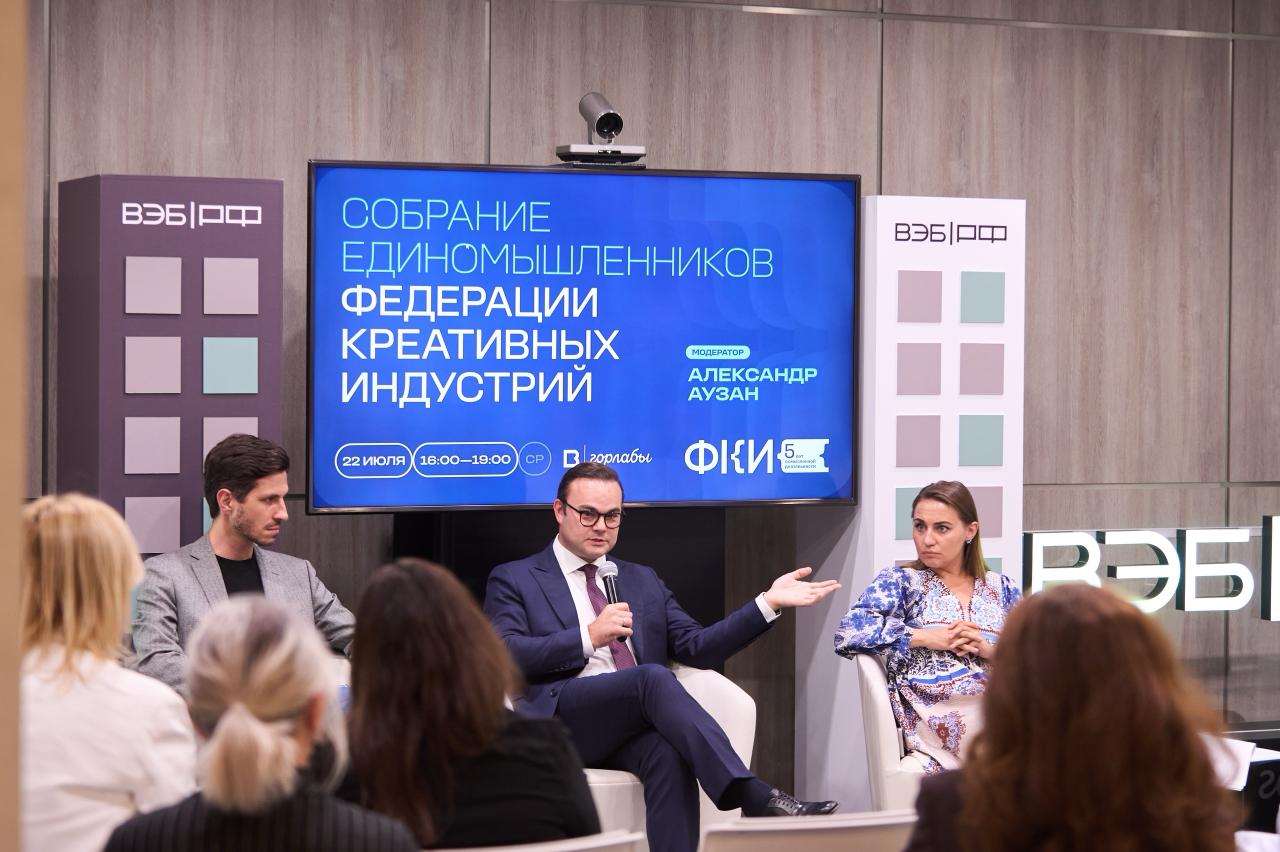
On July 22, the Federation of Creative Industries (FCI) held its Community Meeting at VEB.RF Urban Labs in Moscow. The open discussion brought together industry leaders, policymakers, and business representatives to examine the impact of artificial intelligence on the creative industries and explore the sector’s development scenarios through 2030.
The event convened members of the Federation, partners, leading experts, and representatives of the creative economy for an open dialogue on the sector’s current challenges and future trajectory. The discussion was moderated by Alexander Auzan, Chairman of the FCI Board and Dean of the Faculty of Economics at Lomonosov Moscow State University, with FCI CEO Igor M. Namakonov serving as co-moderator.
Among the participants were Irina Yakovleva, Deputy Chair of the Russian Center for the Management of Rights to Creative Works; Granislava Artemyeva, Director of Partnership Development at the Digital Division of Prosveshcheniye Group (VEB.RF Group); Gasan Gasanbalayev, Executive Director for Social Development at the Far East and Arctic Development Corporation; Kirill Zhigarev, Deputy Minister of Investment, Industry and Science of the Moscow Region; Lidiya Roy, Director of the Creative Economy Center at the Moscow School of Management SKOLKOVO; Vladimir Garev, Managing Partner at Grape Advertising Agency; Maxim Kuzin, Founder of Kuzin Machinery; and other industry experts.
The first session focused on the challenges arising from Russia’s new Artificial Intelligence Law, adopted on July 8, 2026.
Participants agreed that perceptions of AI remain fragmented across different creative sectors, making it difficult to develop coordinated, system-wide solutions.
Irina Yakovleva described the current legislation as a framework law and emphasized the need for clearer regulation of intellectual property rights.
“The law is important, but at this stage it provides only a general framework. The key challenges remain the definition of AI-generated content, the distinction between human authorship and machine-generated outputs, and the use of data for AI model training.”
She also noted that upcoming discussions on implementing regulations are not expected to address intellectual property issues, despite the fact that they lie at the core of the creative industries.
Granislava Artemyeva spoke about the major transformation underway at Prosveshcheniye Group and the launch of a new Artificial Intelligence curriculum for secondary schools beginning on September 1, 2026. Designed for students in grades 5–9, the program promotes a thoughtful and responsible approach to AI technologies. Developed by approximately 30 Russian experts from the AI Alliance, the curriculum will be regularly updated and includes practical exercises, gamified learning, as well as modules on copyright and ethics.
“It is essential to teach students not simply how to use artificial intelligence, but how to think alongside it—treating AI as a tool that enhances human capabilities rather than replacing human thought. Particular emphasis is placed on developing logical reasoning, communication, teamwork, and creativity, all of which are becoming increasingly valuable in the age of AI.”
Participants concluded that the Federation of Creative Industries is uniquely positioned to consolidate perspectives from across the sector, creating a comprehensive picture that can inform future regulatory and institutional initiatives.
Alexander Auzan emphasized that artificial intelligence is becoming one of the most significant drivers of social transformation, with an impact extending far beyond the technology sector.
“Artificial intelligence is adopted slowly but spreads with the persistence of a smoldering wildfire. On the one hand, humanity has gained access to an extraordinarily powerful form of intelligence. On the other, when people stop thinking independently, they rapidly lose their own cognitive abilities. The key question today is not only how technologies evolve, but how people, institutions, and the rules governing them must change to ensure this new power benefits society.”
The second session turned to cooperation between the creative industries, government, and business.
Gasan Gasanbalayev explained why the Far East and Arctic Development Corporation actively supports the creative economy.
“Values matter. Creative economy products help strengthen people’s pride in their regions and in the country as a whole while promoting the Russian Far East—a place that more than 80% of people living in the European part of Russia have never visited.”
Participants noted that while regional governments continue to define sector priorities, build creative clusters, strengthen education, and expand support measures, public funding remains slow to reach projects. At the same time, the shortage of private and corporate investment has become one of the main obstacles to implementing ambitious creative initiatives.
Lidiya Roy observed that creative approaches are already delivering measurable productivity gains and cost savings across traditional industries. However, she stressed the need for a strong system integrator capable of explaining the economic value of creative solutions to major businesses in terms of profitability, competitiveness, and long-term growth.
Kirill Zhigarev highlighted the challenges facing the Moscow Region. Although the region hosts numerous technology parks, most focus primarily on industrial production. At the same time, the regional government is seeking effective mechanisms to support more than 3,500 creative companies and expand cooperation with large businesses. One of the key barriers, participants noted, is that corporations often remain unfamiliar with creative SMEs and struggle to understand their value proposition. In this context, educating large businesses has become a strategic priority, reinforcing the Federation’s role as a key integrator capable of facilitating dialogue between corporations and the creative sector.
Summing up the discussion, Alexander Auzan outlined three strategic priorities for the Federation.
“First, we must consolidate the fragmented understanding of AI across different creative sectors in order to develop a coherent, systemic approach. Without that, our responses will remain isolated rather than strategic. Second, we need to intensify our engagement with large businesses. Without rapid private investment, promising projects stall, while public funding is often slow and difficult to access. Unless corporations learn how to work with creative entrepreneurs and invest in them, progress will remain limited. Third—and perhaps most importantly—we must create a functioning market for intellectual property rights. Without it, we may have creative industries, but we will not have a true creative economy.”
FCI CEO Igor M. Namakonov concluded by emphasizing the importance of sustained dialogue with the professional community.
“Today’s meeting demonstrated how valuable open and honest conversations with the creative community have become. We intend to hold these Community Meetings on a regular basis to stay connected with the industry, monitor changes in market sentiment, and adjust our priorities accordingly. This will allow the Federation to continue serving as an effective bridge between creative entrepreneurs, government, and business.”
Photos from the event are available here







4th floor, room 10, Moscow, 127055, Russia
4th floor, room 10, Moscow, 127055, Russia